Health and Beauty
Is a Gluten-Free Diet Healthy?
Is
Gluten Free Healthy?
You've
most likely either heard of the gluten-free trend, are gluten-free
yourself or many of your girl friends are. To be gluten-free means we
have to avoid all wheat, rye, barley and even oat products. In other
words: no pizza, no bread, no pasta and no granola to name just a
few. Why would we do that? Is a gluten-free diet healthy? To answer
that question we really need to look deeper into the issue.
What
is Gluten?
Gluten
is the general term to describe the protein in grains; especially
prevalent in wheat, barley and rye. It is what gives elasticity to
dough. It's yummy, and actually a healthy protein. Then why avoid
it? Because many people feel so much better when they stay away from
gluten. Others actually cannot eat it without severe reactions. Why
is there an intolerance to gluten?
Why
would I react to Gluten?
Some
people are born with Celiac disease. Others, like myself, suddenly
find themselves intolerant to gluten after years of eating gluten
without a problem. Here are some of the reasons why we would react
to gluten:
1.
Our Genetic
predisposition is a cause of allergies.
2.
An unhealthy
diet
is also a reason. A poor diet that lacks healthy animal fats
during childhood can cause weak intestinal walls (or “leaky
gut syndrome”). Leaky gut syndrome is where partially
digested food passes into the blood stream.
3.
Also, sugar and refined carbohydrates in the gut can stimulate an
overgrowth of candida
albicans.
Candida is a natural fungi that breaks down “dead” foods.
With a diet that includes an over-consumption of dead foods, (like
sugar and refined carbohydrates), candida multiply uncontrollably.
Heavily yeasted foods can also encourage an unhealthy multiplication
of candida. The yeasts will actually change form, attach and grow
into the intestine, causing holes where undigested foods and toxins
can enter the bloodstream. These toxins also produce candida and
trigger allergic reactions.
4.
Lastly, food allergies can be caused by a tendency
to eat from just a few food families.
Out of 4,000 edible plant species only three of them provide 60% of
the worlds food. (57***) For some of us westerners, we mostly eat
carbohydrates, a little meat, and even less veggies.
Not
only is this kind of diet lacking in nutrients, but it also exhausts
our supply of enzymes which are continuously used to digest such
foods. It is an enzyme (called amylace)
that
actually breaks down carbohydrates into simple sugars. The pancreas
and salivary glands are what produces amylase. Because our food is
grown in mineral deficient fields, picked under ripe, transported
and stored for several days before it reaches us, our food is
compromised and the result: enzyme deficiency. Because of this
deficiency our body reacts in various ways. Including celiac
disease, inflammation, chronic allergies, irritable bowel syndrome
and chronic fatigue.
This
is why we can eat what we believe to be “healthy” (staying away
from the “bad refined stuff”) and still react negatively to our
“healthy” food.
Best
thing to do is cut out the foods that are causing the reactions, eat
your own or locally grown foods, stop consuming “dead” foods,
take enzymes with meals and consider doing a candida yeast cleanse.
So
am I just intolerant or do I have an allergy?
Difference
between Allergy and Intolerance
Allergy
a
damaging immune response by the body to a substance, especially a
pollen, fur, a particular food, or dust, to which it has become
hypersensitive.
Intolerance
an
inability to eat food or take a drug without adverse side effects
Most
prevalent allergies are milk and grain products, namely casein and
gluten. Casein and gluten are both proteins, and are two of the
hardest proteins to digest.
 Traditional
cultures normally sprouted or soaked their grains and cultured or
fermented their dairy products.
Traditional
cultures normally sprouted or soaked their grains and cultured or
fermented their dairy products.
“Gluten
intolerance is associated with a family history of alcoholism,
arthritis, Down's symdrome, and mental disorders such as
schizophrenia and dementia. Gluten intolerance has been linked with
vitamin B6 deficiency. People with poor adrenal function are often
unable to tolerate carbohydrates in any form.” (56***)
Rashes,
fatigue, insomnia, headaches, joint pain and hoarseness are all
warning signals from our body, telling us that we are allergic to a
food.
What
is the Difference between Celiac and Gluten Sensitivity?
Celiac
disease is a true allergic reaction to gluten. Gluten in a person
with celiac disease results in an attack on it's own tissue.
Intestinal damage then occurs. And is thus an autoimmune disorder.
Autoimmune
of
or relating to disease caused by antibodies or lymphocytes produced
against substances naturally present in the body.
An
autoimmune disease is when the body mistakenly makes antibodies
against itself, treating healthy organs and tissues like foreign
invades.
An
intolerance is not an autoimmune disorder.
Gluten
intolerance, or non-celiac gluten sensitivity, is an innate immune
response.
In
other words a natural response to intestinal issues. It is less
serious than celiac disease with little intestinal damage and even
though people who are gluten intolerant cannot consume gluten they
will not show positive on a celiac disease test. Gluten intolerance
also does not result in “leaky gut syndrome” like celiac disease.
Gluten intolerance is different than an allergy because allergies
are associated with IgE assays. People with gluten intolerance show
negative on wheat allergy tests.*
“Researches
have concluded that celiac disease and gluten sensitivity are
'different clinical entities' marked by unique immune responses.”
**
So....is
a Gluten-free Diet Healthy?
 Firstly,
I'd like to point out that going gluten-free is really a poor method
to lose weight. I know of some people who have lost weight going
gluten-free because they cut out their major carbohydrate intake.
But normally people will just replace their gluten products with
gluten-free products. Packaged gluten-free products are not
healthier than whole-grain products. Going gluten-free is not a
healthy diet. Replacing your gluten carbs with gluten-free carbs
will not make you lose weight.
Firstly,
I'd like to point out that going gluten-free is really a poor method
to lose weight. I know of some people who have lost weight going
gluten-free because they cut out their major carbohydrate intake.
But normally people will just replace their gluten products with
gluten-free products. Packaged gluten-free products are not
healthier than whole-grain products. Going gluten-free is not a
healthy diet. Replacing your gluten carbs with gluten-free carbs
will not make you lose weight.
Going
gluten-free can be a healthy diet. But this requires baking things
from scratch with soaked or fermented wheat alternatives, or
replacing the bread/noodle/crust with a vegetable. I know someone
that uses eggpant as their pizza crust. I often shred squash into
“noodles” as my pasta alternative. But beware, you can be just
as unhealthy buying gluten-free packaged products as when you were on
gluten. Many gluten-free treats are actually even unhealthier
because the producers are trying to mask the dry unstickiness of
their gluten-free product with sugar. Just read the labels.
The
only reason a person should go gluten-free is if they are intolerant
to gluten or have celiac disease. A better way to lose weight would
be to start completely avoiding unhealthy refined carbohydrates,
keeping your healthy carbohydrates to a balance and exercise.
Gluten-free is not the answer to weight loss.
So
naturally people ask, is a whole-grain diet healthy then?
 Is
a Whole Grains Diet Healthy?
Is
a Whole Grains Diet Healthy?
Whole
grains are much more healthy than refined, bleached, highly
processed, dead grains. The thing to keep in mind is that our
forefathers ate their grains soaked or fermented. Nourishing
Traditions points to India's fermented rice and lentil dishes,
Africa's soaked corn soups and stews, and their fermented millet
porridge; Oriental and Latin America's fermented rice dishes,
Ethiopian fermented injera bread, Mexico's corn cakes, Europe's
fermented starters for breads and American sourdough breads and
pancakes and biscuits. (***452).
 The
unfortunate thing about advising a whole grain diet is the fact that
many forget that these grains are, yes much more healthy, but also
very hard to digest. All grains contain an organic acid called
“phytic acid” in the outer shell. Without soaking, or sprouting
, this acid can block absorption of many minerals (such as calcium,
magnesium, copper, iron and zinc) in the intestinal tract. A diet
high in whole grains without fermentation can easily lead to serious
mineral deficiencies, bone loss, and irritable bowel syndrome.
Soaking allows enzymes to break down and neutralize the phytic acid
as well as enzyme inhibitors.
The
unfortunate thing about advising a whole grain diet is the fact that
many forget that these grains are, yes much more healthy, but also
very hard to digest. All grains contain an organic acid called
“phytic acid” in the outer shell. Without soaking, or sprouting
, this acid can block absorption of many minerals (such as calcium,
magnesium, copper, iron and zinc) in the intestinal tract. A diet
high in whole grains without fermentation can easily lead to serious
mineral deficiencies, bone loss, and irritable bowel syndrome.
Soaking allows enzymes to break down and neutralize the phytic acid
as well as enzyme inhibitors.
Protein
in grain (namely gluten) is difficult to digest. A high diet in
whole grains is an enormous strain on the digestive system. When
this system is overtaxed the result is allergies, celiac disease,
chronic indigestion and candida overgrowth. Unlike animals, we don't
possess four stomachs to break proteins down. Our healthy whole
grains must be fermented.
 Summary
Going
gluten-free is a necessary health choice for some people. Yet a
gluten-free diet is not a great way to lose weight and actually can
be just as unhealthy as a diet with gluten. Gluten is a healthy
protein, but hard to digest. All our grains, whether they include
gluten or not, are easier on the digestive system when soaked as they
were traditionally.
Celiac
Disease is an allergy and an autoimmune disorder. Gluten sensitivity
is an intolerance.
Not
everyone needs to be gluten-free, but if necessary, it can be done in
a healthy way.
Resources
*www.celiaccentral.org
***Nourishing
Traditions,
Sally Fallon, 1999 Washington DC: NewTrends Publishing Inc.,
2001.Print.
Related
Media


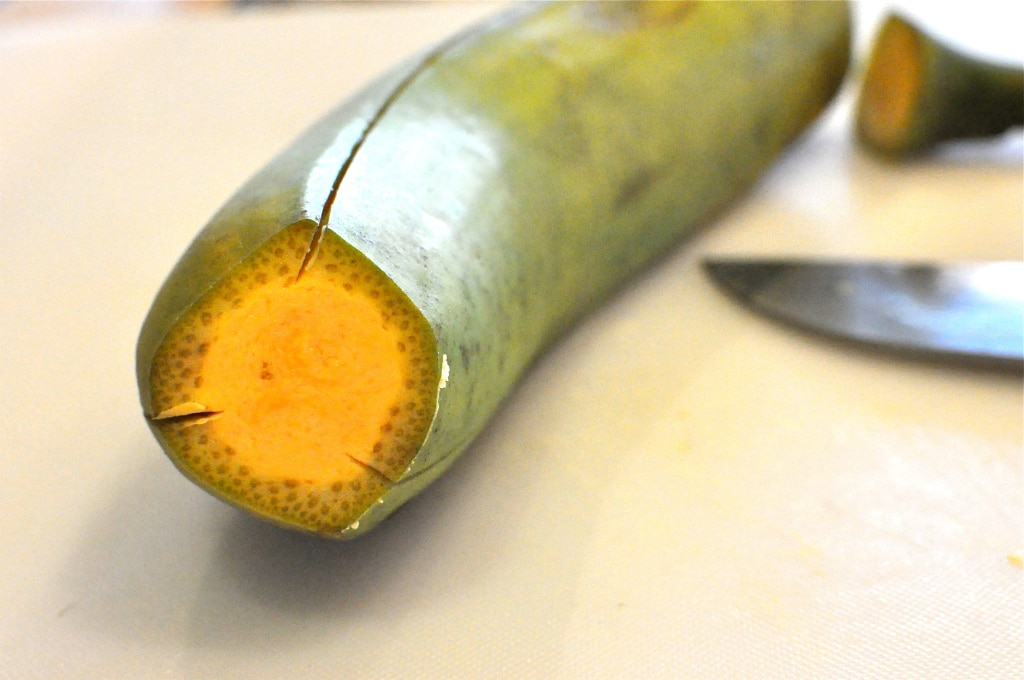 Plantain fruit looks a lot like a banana -- it's part of the banana family. Plantain are more starchy with less sugar than "dessert bananas" and are normally cooked before being eaten. In tropical regions plantain is a staple, eaten much the same way we would treat potatoes. This makes a lot more sense to make a tortilla out of the fruit than the weed. (Although plantain weed is totally edible, yet quite unrelated to Plantain fruit!) :)