Luke 8:54

"And he put them all out, and took her by the hand, and called, saying, Maid arise." Luke 8:54
Showing posts with label pregnancy. Show all posts

Friday, April 10, 2015

Ectopic/tubal Pregnancy Abortion

Political/World Issues
Health and Beauty

Ectopic/tubal Pregnancy Abortion

Recently, I was addressed with the question: "Is abortion acceptable in a case of Ectopic/tubal pregnancy?"  Honestly, I didn't know that much about it. All I could really say on the subject was what I’d just heard from other people’s perception of it. So, today I did my research. I was amazed by what I learned. The truth is, the more I study and educate myself about health in general, the more I see why it is so important to do so. You almost have to be your own doctor, because you cannot simply believe what others will tell you or blindly follow the flow of society. I hope this information is maybe helpful to you, and if nothing else, educational. So, I would encourage you, reader, to research and to study for yourself. It is good to know what we believe and why.

So, what is Ectopic Pregnancy?
Definition of ectopic

  •     Pregnancy with the fertilized embryo implanted on any tissue other than the uterine lining
  •         95% of ectopics are in the tube, 1.5% abdominal, 0.5% ovarian and 0.03% are in the                 cervix
  •         Only a 2% chance that a pregnancy will be Ectopic/tubal


My perception of "Ectopic/tubal pregnancy" from all I'd ever heard was that it was a case where, if not somehow prevented, the baby would inevitably always die and the mother could possibly then die as well. MOST people think this is true and therefore use an abortive, either drug or surgery, to immediately end the pregnancy. If the baby is dying anyway, and the life of the mother is therefore then put at risk, why would you hesitate to abort the baby? Although this thinking logically does make sense, it didn't sit right with me. How could it ever be acceptable to murder a baby? It couldn't be.

Every "medical website" said the same thing. With Ectopic pregnancy there is no other option than to abort the baby immediately before you put yourself at fatal risk. The doctors would advocate that you go in for emergency abortive surgery. A few websites admitted to certain "exceptions" or "rare cases" where the baby somehow survived outside the mother's uterus. But those were rare and somewhat unacceptable.

When I came across a story of a mother that safely kept her Ectopic baby full term, I was pleasantly surprised and it opened an avenue of information! Here is the account:

Rare baby survives outside womb: Montreal doctor
CBC News Posted: Aug 12, 2003 10:16 AM ET Last Updated: Aug 12, 2003 10:16 AM ET

Surgeons in Montreal performed a C-section and found a baby managed to grow and develop outside his mother's uterus. Dionne Grant, 29, and her newborn son should be going home later this week. Although she is camera shy, Grant wanted the world to see her baby. He does not yet have a name. Dr. Robert Sabbah, head of obstetrics and gynecology at Sacr-Coeur Hospital, said he only discovered the problem after deciding to perform an emergency caesarean section on the Jamaican tourist last week.
"When I opened the cavity I quickly discovered that the uterus was not like it was supposed to be," said Sabbah. "As soon as I explored the abdominal cavity I noticed there were feet in the cavity just floating around. So as fast as I could I took out the baby."
He said that abdominal ectopic pregnancies occur in one in 10,000 pregnancies. In 99 per cent of the cases, the babies die. There are only a dozen similar cases in the world, according to obstetricians. Doctors believe the baby survived because the placenta glued itself to the top of the uterus, accessing blood to nourish the baby. Sabbah said he's thrilled to have been part of the surgery and even more thrilled that both his patients are doing so well.


Ectopic/tubal pregnancy baby survivors actually aren't as impossible as I would have thought. I think the reason they are more uncommon, is because woman are told that the "abortion of the baby" is the ONLY option and therefore, the baby is never even given the chance to try to live. I was shocked by how many stories I came across where the mother actually was somehow able to carry her baby even outside the uterus lining. Weird. But it is possible. It is most common, however, that the baby will naturally die. At approximately 8 to 9 weeks most tubal pregnancies will rupture. This can be dangerous for the mother, with risks of hemorrhaging, internal bleeding, and possible infection, and it is extremely important that she gets medical help; although, it is still not unheard of that both the baby and the mother survives even a tubal rupture. (I'm honestly unsure how that works, but I do believe the baby has to be past 28 weeks.) 


So, is it actually as dangerous a threat to the mother's life as is commonly made out to be?

No, not really. And while there is a chance that the mother could die, it isn't as high as I would have thought. I found this particular website, and the information from it, extremely helpful. http://www.personhoodinitiative.com/articles.html

The actual survival rate is more likely to be 99.4%.

 A more accurate percentage could be obtained by considering that deaths associated with ectopic pregnancies only make up about 6% of the yearly maternal deaths in America. If this figure were to be applied to the maternal mortality rate of southern Israel, we would derive that there were .03 ectopic related deaths per year for that region. When that figure is divided by an average of 4.8 tubal ruptures per year, we arrive at the conclusion that a woman in southern Israel has a 99.4% chance of surviving an ectopic pregnancy which is not aborted prior to rupture.

A similar calculation for America produces a lowest possible minimum of 97.7% survival.

    In addition, we could calculate the maternal risk from the total number of heterotopic pregnancies (twins with one child in the womb and the other being ectopic) in America. According to Dr. Tenore of the Northwestern University Medical School in Chicago, this type of pregnancy occurs in 1 out of every 2,600 pregnancies, and 50% of them (1 out of every 5,200 pregnancies) "are identified only after tubal rupture." According to the American Pregnancy Association, there are approximately 6 million pregnancies per year in the US. Therefore, there are an average of 1,154 heterotopic pregnancies every year in America which are not even discovered much less treated prior to tubal rupture. The CDC reported that there are an average of 26.3 maternal deaths per year that are ectopic related. If we assumed that all of these ectopic related deaths were the result of an undiagnosed heterotopic pregnancy (a condition which only makes up 1% of the total number of ectopic pregnancies), then we would still arrive at a maternal survival rate of 97.7%.

     The claim that an unborn child cannot survive an Ectopic pregnancy:

a. Between 1809 and 1935, there were 316 reported live births from ectopic pregnancies.

 Two OBGYNs in New York, Dr.’s Hellman and Simon, published details on 316 ectopic pregnancies which resulted in live births between 1809 and 1935. Only half of these children survived their first week of life, but these births occurred before the development of the first neonatal intensive care unit, and most of them before the discovery of penicillin in 1928.  With modern technology, it is likely that many more would have survived.

b. With modern technology, there have been even more of these births in recent years in spite of the insistence that abortion is the only viable treatment.

    In September of 1999, Ronan Ingram was successfully delivered via c-section.  Ronan had implanted in one of his mother’s fallopian tubes which subsequently ruptured as he grew into the abdominal cavity. In May of 2008, Durga Thangarajah was born after spending a full nine months in her mother’s ovary. Sage Dalton was born in July of 1999 after developing in the amniotic membrane outside her mother’s womb. Billy Jones was born in 2008 after developing in his mother’s abdominal cavity. Many additional reports could be given.

The claim that termination is the only treatment for ectopic pregnancies that is recognized by the medical profession:

 Many OBGYNs have recommended allowing ectopic pregnancies to resolve on their own.
Dr.’s Sapuri and Klufio, for example, have recommended that women discovered to have an ectopic pregnancy prior to 28 weeks of gestation should be admitted to a hospital and closely monitored.  They stress that blood transfusion facilities should be readily available in case of hemorrhage, and they suggest that once the child has reached 28 weeks of gestation, he should be delivered surgically.


An Ectopic/tubal pregnancy certainly could be dangerous and definitely isn't ideal, but it isn't impossible either. Abortion isn't the only option, as doctors conclude and people ignorantly and blindly believe. It shouldn't even be an option. If there is still a possibility that you could save your Ectopic/tubal pregnancy...why wouldn't you try? If there was even a small chance that you could somehow keep the life of your baby, isn't that something to consider? To most doctors and pro-choice representatives, it is seen only as a "blob of tissue" that could possibly be a fatal risk, so they insist on immediate removal. And I think maybe even most pro-life christians just blindly believe what the doctor tells them to do. But it is a life. And outside the mother's uterus or not, it is worth fighting for.


Saturday, January 17, 2015

What is Abortion?

Political/World Issues    

What is Abortion?
So many people have no idea.  Amazingly many people who oppose it have little knowledge of what abortion actually is.  I have come to believe that it is a major reason why we don't do anything about it.  If you knew, you couldn't help but desire to do something.  You would do something.

Abortion has become a word that has lost it's definition, a political term bantered back and forth. We have become callous towards a word that means so much more than “a legal and safe way to end pregnancy”, as Planned Parenthood defines it. It's more than “a forced removal of a fetus from the womb”, as Wikipedia describes.

This became apparent to me when I decided to educate myself on the procedures of abortion. I was disturbed. No, that's an understatement. My soul weeps and I am left speechless and in horror. Do you have any idea?

Prepare yourself -- once you know you will be moved into action.  Doing nothing will no longer be an option.  

(The following includes some graphic illustrations and photos along with detailed information on the procedures of abortion methods.  This post would be inappropriate for young children under twelve).

SUCTION CURETTAGE OR VACUUM ASPIRATION ABORTION:


The Stats:

Suction curettage (or vacuum aspiration) abortion is the most commonly used method of abortion around the world.  This is because most abortions are performed in the first trimester. 

 The National Abortion Federation (NAF) has reported that

"...virtually all modern first-trimester surgical abortions are accomplished by vacuum aspiration." 1


The Procedure:


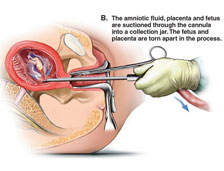
Suction Abortion Illustration - 01Firstly, a speculum is placed in the vagina, a tenaculum is clamped to the lip of the cervix, and a cannula is inserted into the uterus.


Secondly, the amniotic fluid, placenta and fetus are suctioned through the cannula into a collection jar.  The fetus and the placenta are torn apart in the process.
Suction Abortion Illustration - 03Suction Abortion Illustration - 02

Lastly, the uterine cavity is scraped with a curette to determine if any tissue remains.

(Images taken from www.nucleuscatalog.com)


The NAF reports that removing a fetus at 16 weeks old "forceps may be needed to extract some fetal parts such as the calvarium (skull) or spine."2
Although the suction curettage method isn't commonly used after 12 weeks gestation.

12 week embryo:


  To confirm and complete an abortion the embryos tissue must be examined after the abortion has been completed.  Small embryo parts are apparent at even 9 weeks gestation "and become easier to identify thereafter."

If body parts are too large the the abortionist uses " a ring forceps to remove any material that is wedged in the end of the cannula or lodged at the external os."5 

The Doctor's Description:

Warren Hern (author of Abortion Practice) describes his post-abortion procedure this way:
As the physician completes the procedure, he should inform the patient that the procedure is being completed… Keeping the vaginal bimanual examination hand sterile, the physician removes the speculum with the other gloved hand and proceeds to conduct a postoperative bimanual examination. If the uterine size seems larger than expected, the physician should replace the speculum and determine whether, in fact, the procedure has not been completed… As I complete the bimanual examination, I ask each patient to place the fingertips of both her hands over the uterus and rub constantly for 2 hours… this will help the uterus to contract and thereby stop the bleeding and cramps.6


After the examination is finished, Hern reassures the woman that "she is no longer pregnant." According to Hern, many of them cry.7


EARLY MEDICAL ABORTION:


The Stats:


Medical abortion describes another method of abortion usually used in the first months of pregnancy. The drug used is Mifepristone, sometimes also called RU486, which prohibits the hormone progesterone from functioning properly. 6

Medical abortion is often advertised as a more-natural procedure than surgical abortion.  Although the National Abortion Federation (NAF) emphasizes that there is no moral difference between medical abortion and surgical abortion. They write:
Some patients report that they prefer the medical abortion because it seems like a heavy period or a miscarriage rather than an abortion… It is important for the patient's postabortion well-being that she does not fool herself (into thinking she is not having an abortion) and that the provider does not participate in her self-deception.8

According to the NAF statistics, women who choose medical abortion "like that it is noninvasive and offers more privacy and control," while those who choose surgical abortion do so "because it is quick, predictable, and may be combined with sedation or anesthesia."9 

The Procedure:

This drug takes a three week process to complete abortion.  If it fails a surgical abortion is then scheduled, which the patient signs for before medical abortion is performed.

Unlike surgical abortion, women who medically abort most often see the embryo upon abortion.  Physicians are told to explain this fact to their patients, since patients likely will recognize a body.  These women are shown true to life size illustrations of the embryos (or "products of conception as the NAF states) to avoid potential trauma. 10


~ * ~

Defined!

Embryo: Unborn child after the third week of conception.
Fetus:  A term given to the embryo after week 8.
NAF: National Abortion Federation.  North America's official providers for abortion.
1st Trimester: Week 0-12
2nd Trimester: Week 13-27
3rd Trimester: Week 28- end of pregnancy (about 42 weeks)
Gestation: The process of carrying or being carried in the womb between conception and birth.
Planned Parenthood: In 1921 feminist Margaret Sanger first founded the American Birth Control League which later became Planned Parenthood Federation of America in 1941. Planned Parenthood has since grown to have over 820 abortion clinics in the US with a total budget of $1 billion. 
Abortion: ...to be decided


~ * ~


DILATION AND EVACUATION (D&E) ABORTION:

The Stats:

Worldwide 15% of all abortions are performed after the 2nd trimester.11  That's a little over 150,000 a year, in the United States alone.  It is amazing to note that 96% of all second trimester abortions are performed by the D&E method.12   
 The National Abortion Federation (NAF) reports that most women seeking second-trimester abortion are young and healthy.13 Serious health problems account for only a small proportion of abortions worldwide.14 According to the NAF, the most common reasons for a second-trimester abortion given are, denial or delay in recognizing pregnancy, financial difficulty for obtaining abortion, indecision, or changed circumstances.15

The Procedure:

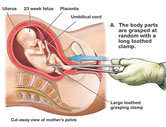
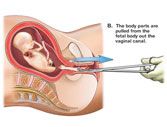
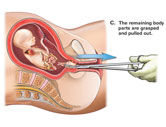
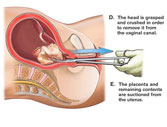
To describe the procedure of D&E abortion: Forceps are inserted through the dilated cervix for the dismemberment and removal of the human fetus.  This requires a 10-12 mm cervical dilation.  But for gestations 17 weeks or more longer and heavier forceps must be used. 

 The NAF reports that "Bierer forceps are the weightiest and largest-jawed [with] fenestrated and sharply serrated jaws (to) provide the most traction."16 The NAF recommends that ultrasound guidance be used "in cases that require a considerable degree of force to remove fetal parts."17 This helps ensure that the abortionist does not accidentally grasp and tear the myometrium (uterine wall) while grasping and tearing apart the fetus.

The National Abortion Federation instructions for a D&E abortion are as follows:
Once the forceps has passed through the internal os, open the jaws as widely as possible to encircle the fetal tissue and avoid pushing fetal parts deeper into the fundus… After 16 weeks' gestation, fetal skeletal development is such that the surgeon can manually sense the presence of fetal parts within the closed jaws… After grasping a fetal part, withdraw the forceps while gently rotating it. This maneuver brings the fetus into the lower uterine segment before the grasped fetal part is separated (if necessary) and removed from the cervix… If a fetal extremity is brought through the cervix without separation, advance the forceps beyond the extremity to grasp part of the fetal trunk. Bringing the fetal trunk into the lower segment markedly reduces the number of instrument passes into the fundus… During the procedure, try to identify and keep track of fetal parts as they are removed. A "pouch' or surgical pan at the edge of the gable to catch fetal parts can assist this process."18


D & E Abortion Illustration - 01D & E Abortion Illustration - 02D & E Abortion Illustration - 03D & E Abortion Illustration - 04

The Doctor's Description:

Warren Hern, who the NAF credits as being an "American innovator"65 in D&E technique, offers the following instruction:
It is better to use smaller forceps and take smaller amounts of tissue each time than to deliver fetal parts intact while traumatizing the cervix… At 16 to 17 weeks, fetal tissue is much more easily identifiable with the forceps and in some ways is easier to grasp and remove than in earlier gestations. The [skull] is about the size of a Ping-Pong ball and usually can be grasped readily with the Bierer. Collapsing it gives a definite sensation… At 18-19 menstrual weeks… fetal parts are significantly larger and more difficult to morcellate(tear into pieces)… [Abortion after the] 20-week gestation… can be a significantly more difficult procedure accompanied by unnerving hemorrhage. Forceps use must be sure and relatively rapid. There is frequently not much time for exploring the nuances of different tissue sensations. Grasping and collapsing the [skull is] often difficult. Stripping the [skull] of soft tissue is sometimes the first step in successful delivery of this part, followed by dislocation of parietal bones. In this case, care must be taken in removal because ossification is occurring and the edges are sharp… Regardless of the amount of dilatation, delivery of the [skull] and pelvis is sometimes difficult… The advantage obtained by having a softened cervix could become a disaster if a laceration develops at the level of the internal os as the result of too much force… The procedure changes significantly at 21 weeks because the fetal tissues become much more cohesive and difficult to dismember. This problem is accentuated by the fact that the fetal pelvis may be as much as 5 cm in width… [The skull] can be collapsed. Other structures, such as the pelvis, present more difficulty… A long curved Mayo scissors may be necessary to decapitate and dismember the fetus, since it may be impossible to apply forceps or to do so while avoiding the thinned-out cervix."19

To verify a complete abortion the fetal parts must be examined.  The foot is often measured to "estimate gestational age after abortion."20

Foot photo at 13 weeks


DILATION AND EXTRACTION (D&X) OR PARTIAL BIRTH ABORTION:


The Stats:

Dilation and Extraction (D&X) is a variant of D&E.  In contrast of the D&E's piece by piece method, D&X delivers the aborted fetus intact and therefore is sometimes called "intact D&E" as in The Partial Birth Abortion Ban Act of 2003 . Politically, it is known as partial-birth abortion.


The Procedure:

The syllabus of the Partial Birth Abortion Ban Act describes the difference between "usual" D&E technique and "intact D&E" this way:


In the usual second-trimester procedure, “dilation and evacuation” (D&E), the doctor dilates the cervix and then inserts surgical instruments into the uterus and maneuvers them to grab the fetus and pull it back through the cervix and vagina. The fetus is usually ripped apart as it is removed, and the doctor may take 10 to 15 passes to remove it in its entirety. The procedure that prompted the federal Act and various state statutes, including Nebraska’s, is a variation of the standard D&E, and is herein referred to as “intact D&E.” The main difference between the two procedures is that in intact D&E a doctor extracts the fetus intact or largely intact with only a few passes, pulling out its entire body instead of ripping it apart. In order to allow the head to pass through the cervix, the doctor typically pierces or crushes the skull.21

The National Abortion Federation (NAF) describes D&X:
Because the cranium represents the largest and least compressible structure, it often requires decompression… Decompression can be accomplished with forceps or by making an incision at he base of the skull through which the intracranial contents are suctioned. If the fetus is in cephalic presentation (head first) with the calvarium well-applied to the cervix, the surgeon can pierce the calvarium with a sharp instrument and collapse it externally.22


If the fetus is delivered feet first the baby's head is crushed with forceps or pierced with scissors.  The brain is then suctioned out by a vacuum aspirator.
If the baby is delivered head first the head is pierced with scissors as soon as the head appears.

The Doctor's Description:

 Warren Hern, who developed the Hern forceps, writes this in Abortion Practice:
Cervical obstruction by the calvaria (skull) is a paradoxical problem, since it is the opposite of having difficulty in recovering tissue… Small instruments cannot encompass it; large instruments… either push it away, cannot be closed once the [skull] is grasped, or, having grasped the [skull], cannot be withdrawn. Unless the [skull] can be collapsed and delivered, however, the procedure cannot be completed… and the risk of complications begin to increase. The most useful maneuver in this case is to grasp the presenting of the [skull] with the cervical tenaculum, stripping away the soft tissue (skin). When the skull bones are visible, they are grasped also with the tenaculum. A long curved Mayo scissors is then used to dissect the [skull] to the point that it is opened and decompressed. At this time, a forceps with a very strong blade and firm grasp… may be used to grasp the tentorium and skull plates, sometimes dismembering by torsion and sometimes by sharp dissection with the Mayo (scissors)… Once some dismemberment has taken place, the operator may take a somewhat larger forceps… As the tissue is pushed slightly up in to the uterine cavity, the forceps blade is opened and a moderate amount of tissue is grasped… With good dilatation and effacement, the entire fetus may be delivered.23

In 2007 the Supreme Court upheld the Partial Birth Abortion Ban Act of 2003, which states: "punctur[ing] the back of [a] child's skull with a Sharp instrument, and suck[ing] the child's brains out before completing delivery of the dead infant -- is a gruesome and inhumane procedure that is never medically necessary and should be prohibited."24  

The NAF condemns both Congress and the Supreme Court for "denying reproductive freedom"25 and "ignor[ing] the best judgment of the medical community."26 Included among their reasons for why D&X can be more advantageous than D&E is the assertion that it "permit(s) more complete morphologic evaluation of an extracted fetus,"27 it "minimizes the risk of retained tissue,"28 and it gives grieving parents "the opportunity to view or hold an intact fetus."29

While D&X is prohibited, the Partial Birth Abortion Ban can be circumvented.   

The NAF advises abortionists to kill the baby by injection prior to performing a D&X procedure. According to the language of the Ban, it is "applicable only when a 'living fetus' is present at the outset of evacuation."30

The NAF offers the following advice for killing babies by injection:
Digoxin in doses of 1.0 to 1.5 mg appears to effect fetal demise. Providers may feel a change in resistance at the needle tip as it enters the fetus. Unless the needle is in the fetal cardiac chambers, aspiration will not usually yield fetal blood… fetal demise occurred in 43% at 2 hours; 75% at 3 hours , and 98% in 5 hours… Potassium chloride will not achieve fetal demise when injected into the amniotic fluid; injection into the fetal heart or umbilical cord is required… Needle placement should be maintained until fetal death is confirmed monographically. These technically challenging procedures are performed most commonly for multifetal pregnancy reduction… Clinicians typically administer agents to cause fetal demise 1 to 2 days before D&E, often in conjunction with cervical preparation.31


So, what is abortion?  It's destruction...legal premeditated murder. A heinous crime. Termination; a cruel tortuous death performed upon an innocent.  
Now you know.  

So what are you going to do about it?

Check out Voices of Dissidence to find out how you can begin to do something about abortion.


Main Resource: www.abort73.com